

In an effort to make up for the short comings of the posts the past two weeks, I am going to try to correct that and delve deeper in to what I am planting. It’s one thing to tell you what I am planting and it is another thing to tell you the specifics about each plant and why I chose it. The fun bit will be learning about the successes and the failures. I haven’t had my own garden before and I think it is going to show. Did I choose the right species or should have I gone with another choice… let’s go out on a limb and guess I should have made other choices. 🤣 I also want to record the yield from each plant. Is what I planted going to provide me more than I could ever hope of consuming? Yes, I can preserve my harvest but remember last week’s post? I still work a full time job. I am also single. I will be giving away a lot of what I grow and the thought of selling at a farmer’s market next season is intriguing.
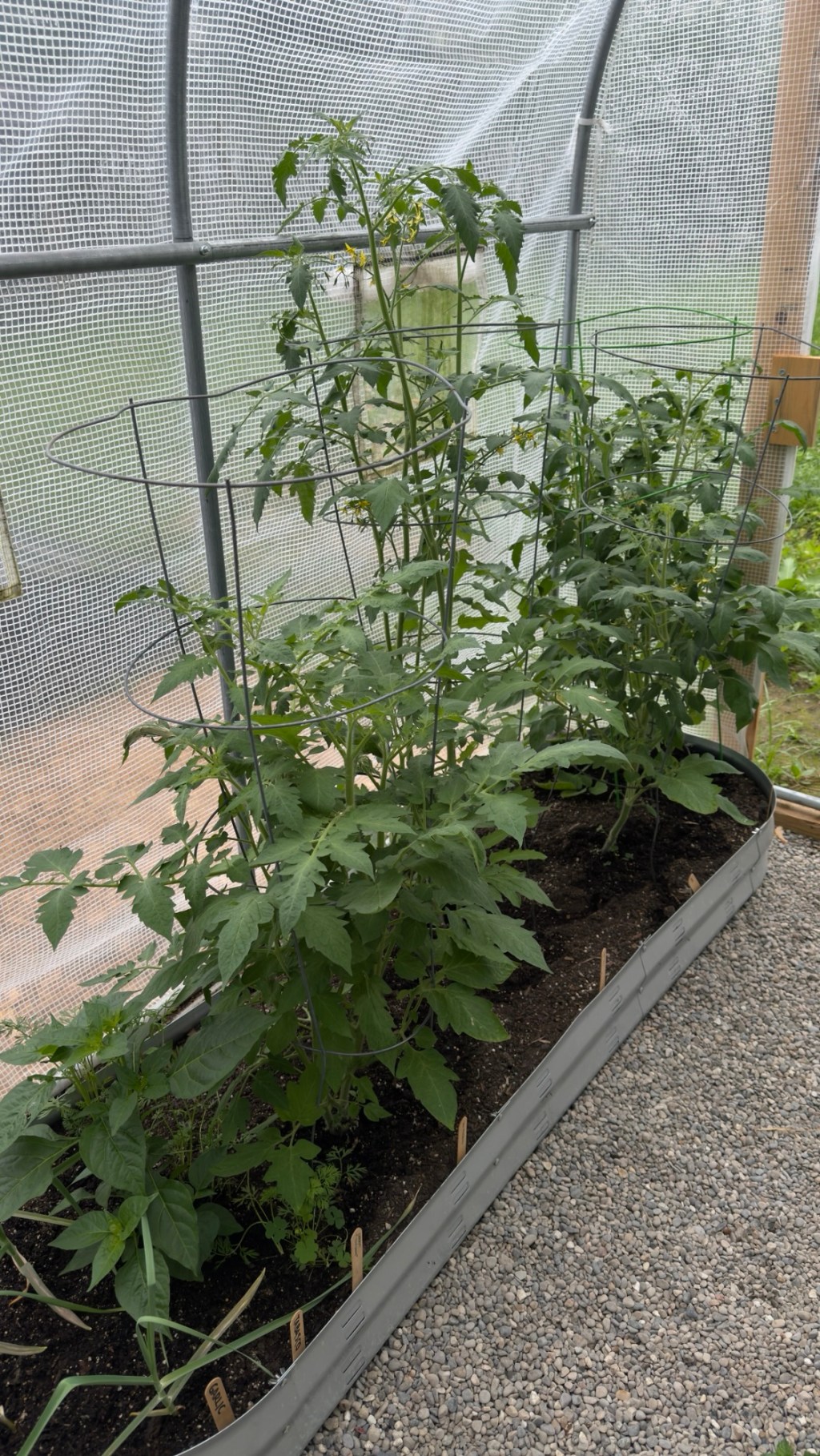
This week will be all about tomatoes, specifically the San Marzano. I started eight varieties of tomatoes from seed in February and planted four. The four varieties out of the eight I planted were chosen with cooking, eating, and uniqueness. In hindsight, I should have located the herb bed outside and used the second raised bed in the greenhouse for the other four tomato varieties. Oh well, I’ll know better next season. The four varieties of tomato plants I have right now are a San Marzano, a cherry tomato called Sungold, Roma, and a unique tomato called Brad’s Atomic Grape. Let’s dive in and learn!
San Marzano
I have planted San Marzano tomatoes mainly because I have never grown them before. Even though I have not had a proper garden before, I have planted tomatoes in flower beds next to homes or apartments. The San Marzano is considered a paste tomato. What is a paste tomato you ask? Well, this is what Wikipedia has to say:
A plum tomato, also known in the United States as a processing tomato or paste tomato, is a type of tomato cultivated for sauce and packing purposes. It is generally oval or cylindrical in shape, with significantly fewer locules (seed compartments, usually only two) than standard round tomatoes and a generally higher solid content, making them more suitable for processing into paste.
The San Marzano is an heirloom variety of tomato with Italian origins. It is prized for its lower water content, fleshiness, and flavor. I make a lot of spaghetti and buy a lot of tomato sauce and tomato paste. If the San Marzano holds true to what is said, I believe sauce and paste I make from this year’s harvest will rival anything I can buy at the store. Also, by growing San Marzano tomatoes, I can cut down the cans of sauce and paste I have to buy. Maybe even eliminating those purchases. You may be wondering what an heirloom tomato is? Thanks again Wikipedia.
An heirloom tomato (also called heritage tomato in the UK) is an open-pollinated, non-hybrid heirloom cultivar of tomato. They are classified as family heirlooms, commercial heirlooms, mystery heirlooms, or created heirlooms. They usually have a shorter shelf life and are less disease resistant than hybrids. They are grown for various reasons: for food, historical interest, access to wider varieties, and by people who wish to save seeds from year to year, as well as for their taste.
Heirloom tomatoes are generally sweeter and in my opinion, taste better. They are not genetically modified to be disease resistant, to be uniformly red (Heirloom tomatoes have variations in their coloring.), or a long shelf life. San Marzano’s have a longer growing season which makes them perfect for the home garden. If you are looking for a tomato variety that is sweeter and a stronger tomato taste, the San Marzano might be for you.
At the time I am writing this, my San Marzano tomato plant is growing bigger by the day. It has blooms and should start producing fruit any day and I should have bumper crop to harvest about the middle of August. Most tomato varieties take somewhere between 20 to 60 days to go from flowers to ripe tomatoes.
Let’s talk about seeds for a moment.
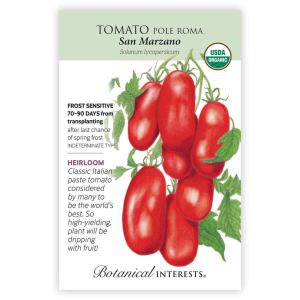
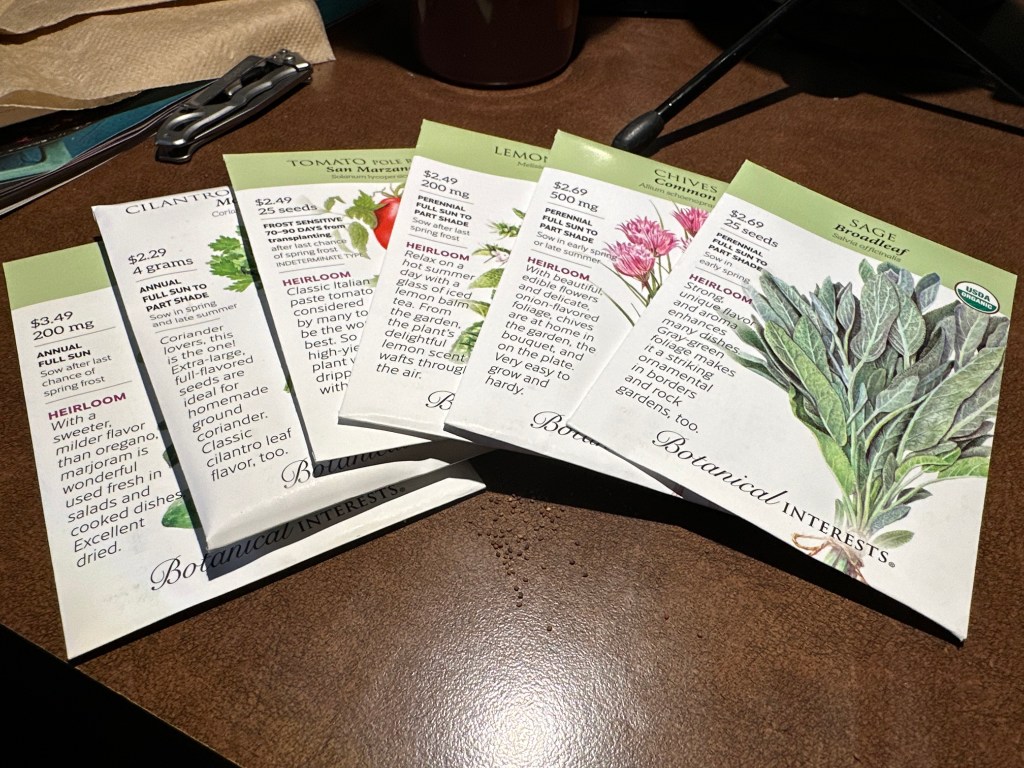
My San Marzano seeds came from Botanical Interests out of Broomfield, CO. and I love the seed packets! The art for each seed packet they sell was drawn by artists and is unique to Botanical Interests. I see interesting art and I purchase! FYI… Botanical Interests isn’t sponsoring this website and are not affiliated with My Hoosier Homestead in anyway. I buy seeds from them with my own money. Also, all images of the seed packets are from the their website at http://www.botanicalinterests.com
Taking a look at the front of the seed packet, you will find the variety, the common name, followed by the scientific name. If the seeds are USDA Organic certified you will find the USDA Organic label. To the left of the art is the sowing information. Below that will tell you if the seeds or native or heirloom and a short description of the seeds.
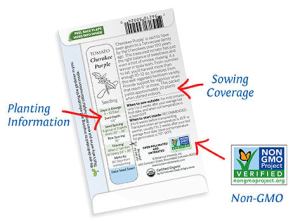
Seed packets from Botanical Interests have the usual information on the back. Here you will find planting information. The section outlined with the dashed line can be cut out and taped to plant stake for identification after you’ve sowed the seeds. This section tells you how many days it will take for seedlings to emerge. It will tell you how deep to sow the seeds, the initial seed spacing followed by how to thin the seedlings, and finally how many days it takes until maturity. i.e. When it is time to start enjoying the pay off for all your hard work. There is a short description of the variety and what is produced. Underneath that is sowing information. When to sow outdoors and when to start seeds indoors. (Some plants do very well when you start the seeds inside during the months of January and February so you can get mature seedlings in the ground as soon as the last frost date has passed.) The final bit of important information you will find on the back of the seed packet is the verified Non-GMO label. All of Botanical Interests seeds are Non-GMO certified.

When you open the seed packet you will find tips on when to harvest, recipes, history, pest control, plus much more.
I buy seeds from a lot of other seed companies and their seed packets have much of the same information. It is just that Botanical Interests goes about and beyond and has designed an artistic, information laden, and compelling art. I think you could take their seed packets, open them up and create art you could hang on the wall! No matter where you buy your seeds from, buy ones that interest you and that you want to try in your garden. It will be gratifying and fun!
Next week…
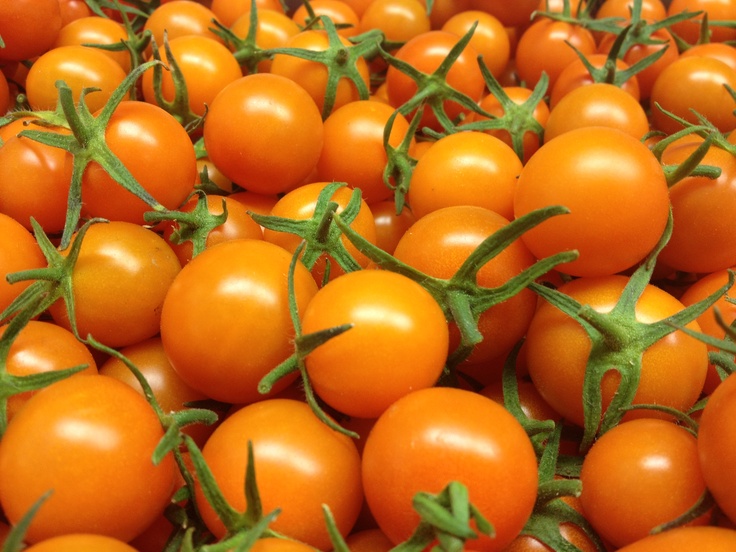
In the mood for a salad? Next week’s tomato is perfect for salads!
Is the San Marzano tomato a good choice?
The San Marzano is a great paste tomato. It is a popular tomato in Italy and many people use them to make tomato sauce. They are a heirloom variety and thus are not genetically modified. They have a long growing season and should produce a lot of fruit. The are fleshier, sweeter, and taste great. So to answer my question… “Yes, I made a good choice!”
As I was writing, I was thinking “Could have I planted one or two more varieties?” The answer to that is yes, and I should have. I should have cut down on the number of herbs and had more room a sandwich variety and a beefsteak variety. Those tomatoes would have been a welcome addition to my menu planning for sandwiches and for when I grilles hamburgers. Maybe I can try that over the winter? I want to conduct an experiment with my greenhouse and see if my setup will allow me to grow produce during the winter months? If successful, I may upgrade to a much larger greenhouse. Who knows?
Did you know?
Did you know that tomatoes are not a vegetable but a fruit? When you look at it scientifically, you will find that many things we consider vegetables are in fact a fruit.
noun
plural fruits , plural fruit.
- any product of plant growth useful to humans or animals.
- the developed ovary of a seed plant with its contents and accessory parts, as the pea pod, nut, tomato, or pineapple.
- the edible part of a plant developed from a flower, with any accessory tissues, as the peach, mulberry, or banana.
- the spores and accessory organs of ferns, mosses, fungi, algae
As odd as it may seem, tomatoes are fruits as are many things we consider vegetables. Plants that produce savory food are thought of as vegetables and plants the produce sweet food are classified as fruits. It is all about marketing. You just can’t have savory fruits!
Hopefully this week has made up for the past couple of week’s short comings and has been an interesting topic. Tomatoes are a versatile fruit/vegtable and is one of my favorite foods. They make spaghetti sauce, pizza sauce, and are great on their own!
Until next Sunday…
— Greg


 My Hoosier Homestead
Leave a comment